SPHERE IoT Enclave
Remote experimentation on real consumer IoT devices
The SPHERE IoT Enclave at Northeastern University enables researchers to remotely interact with physical Internet-connected consumer devices located in our lab, including smart TVs, smart speakers, cameras, smart-home devices, and additional consumer IoT platforms.
The enclave allows researchers to perform realistic and repeatable experiments on unmodified off-the-shelf devices without requiring physical access to the lab. Researchers can remotely control devices, automate interactions, observe device behavior, and collect experimental data using integrated sensing and actuation infrastructure.
The SPHERE IoT Enclave is part of the broader SPHERE project, a collaborative effort with the University of Southern California Information Sciences Institute (USC ISI) and the University of Utah, and is supported by the NSF Mid-scale Research Infrastructure program under award CNS-2330066.

What the IoT Enclave Provides
The enclave was designed to simplify IoT experimentation and make realistic smart-home research more accessible.
- Remote access to real consumer IoT devices
- Repeatable experimentation workflows
- Automated physical interaction with devices
- Multimedia observation and data collection
- Isolation between concurrent experiments
- Support for heterogeneous smart-home environments
Researchers can study:
- IoT security and privacy
- Device behavior and automation
- Cross-device interactions
- Network traffic patterns
- Companion-app ecosystems
- Smart-home interoperability
Example Experiments
The enclave allows researchers to remotely perform experiments that would normally require physical presence in the lab.
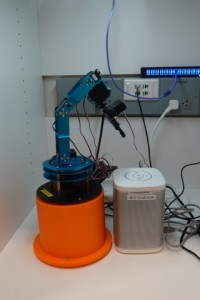
For example, a researcher can instantiate a smart speaker, remotely press the microphone mute button using a robotic actuator, generate a voice command toward the device, observe the device behavior through cameras and microphones, collect the network traffic produced by the device to study whether audio-related communication occurs, and repeat the experiment multiple times to assess consistency.
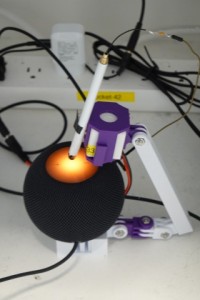
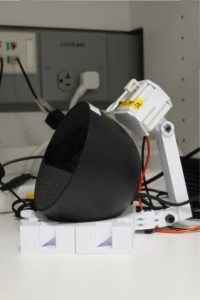
The platform supports highly heterogeneous devices and interaction models. Experiments involving a smart TV may require infrared remote-control interfaces and multimedia capture, while experiments involving a smart bulb may rely on companion-app interactions. The enclave provides the sensing and actuation interfaces appropriate for each device type and abstracts these interactions through a common experimentation framework. This allows similar workflows to be reused across devices from different vendors, and in many cases even across very different device categories when overlapping functionality exists.
Experiments can involve multiple devices interacting within the same smart-home environment. Each experiment executes within an isolated network segment, allowing multiple users to simultaneously run independent experiments involving multiple devices without interfering with each other.
Consumer IoT Devices
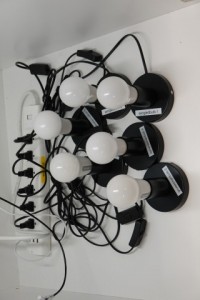
The enclave contains a large and evolving collection of consumer Internet-connected devices representative of modern smart-home environments.
Example device categories include:
- Smart TVs and streaming devices
- Smart speakers and voice assistants
- Cameras and video doorbells
- Smart plugs, bulbs, and sensors
- Smart-home hubs and gateways
Devices are deployed in realistic conditions using unmodified commercial products rather than custom research hardware.
The beta version of the enclave already includes hundreds of IoT devices, with new devices and capabilities added every month. The SPHERE IoT Enclave is expected to support approximately 500 IoT devices by the end of 2027, spanning multiple vendors, ecosystems, and communication technologies.
Remote Interaction Infrastructure
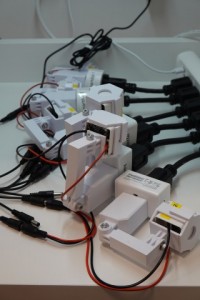
The enclave integrates programmable sensing and actuation systems that allow researchers to remotely interact with physical devices as if they were present in the lab.
Examples include:
- Robotic button pushers
- Infrared remote-control interfaces
- Touchscreen automation systems
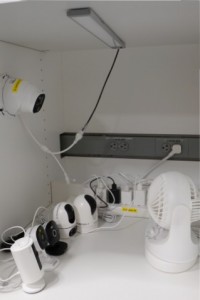
- Cameras and microphones
- Android smartphones for companion-app interactions
These systems make it possible to automate interactions that would normally require direct human presence.

Repeatable Experimentation
The platform was designed with reproducibility in mind. Researchers can create experiments involving multiple devices, automate workflows, and repeat the same setup across multiple experimental runs without manually rebuilding the environment each time.
The enclave supports both exploratory experimentation and long-term reproducible research workflows.
Because the enclave is still in beta, some devices or interaction interfaces may occasionally not function as expected. Beta users encountering issues are encouraged to report them to one of the research engineers listed in the People section below.
Documentation and Access
The SPHERE IoT Enclave is currently in beta and early user access is controlled while the platform continues to expand.
Researchers interested in accessing the enclave may request a beta invitation by emailing:
moniotr@ccs.neu.edu
Please use the subject line:
SPHERE IoT Enclave Beta Access Request
and include:
- Name and affiliation
- Current role
- Intended use or research interests
Invitations are sent as beta spots become available. Because the platform is still expanding, requests may not be processed immediately, and we ask applicants to be patient if access is not granted right away.
Technical documentation and the access portal are available at:
https://launch.sphere-testbed.net/
People
| Name | Role | |
|---|---|---|
| David Choffnes | Professor, Principal Investigator | d.choffnes@northeastern.edu |
| Daniel Dubois | Senior Research Scientist, Tech Lead | d.dubois@northeastern.edu |
| Kevin Aldana | Research Engineer | ke.aldana@northeastern.edu |
| Darsh Pandya | Research Engineer | da.pandya@northeastern.edu |